tekoversity
Published:
Feb 23, 2026
What is Inflation? Why your Savings can Lose Value Over Time
30s Summary
Inflation reduces purchasing power. Your money may grow in number but buy less over time.
Real value matters more than account balance. Focus on what your money can actually buy.
Savings are essential, but not enough for long-term goals. Use them for emergencies and short-term needs.
The real interest rate is what counts. If inflation is higher than your savings rate, you are losing value in real terms.
Avoid extremes. Don’t hold only cash long term, and don’t take excessive risk without knowledge.
Match strategy to time horizon. Short term: safety and liquidity. Long term: disciplined growth investing.
Build first, then grow. Create an emergency fund, then invest consistently.
Shift from consumer to owner. Long-term wealth comes from owning productive assets, not just holding cash.
A Quick Explanation Using a “Bowl of Pho” Example
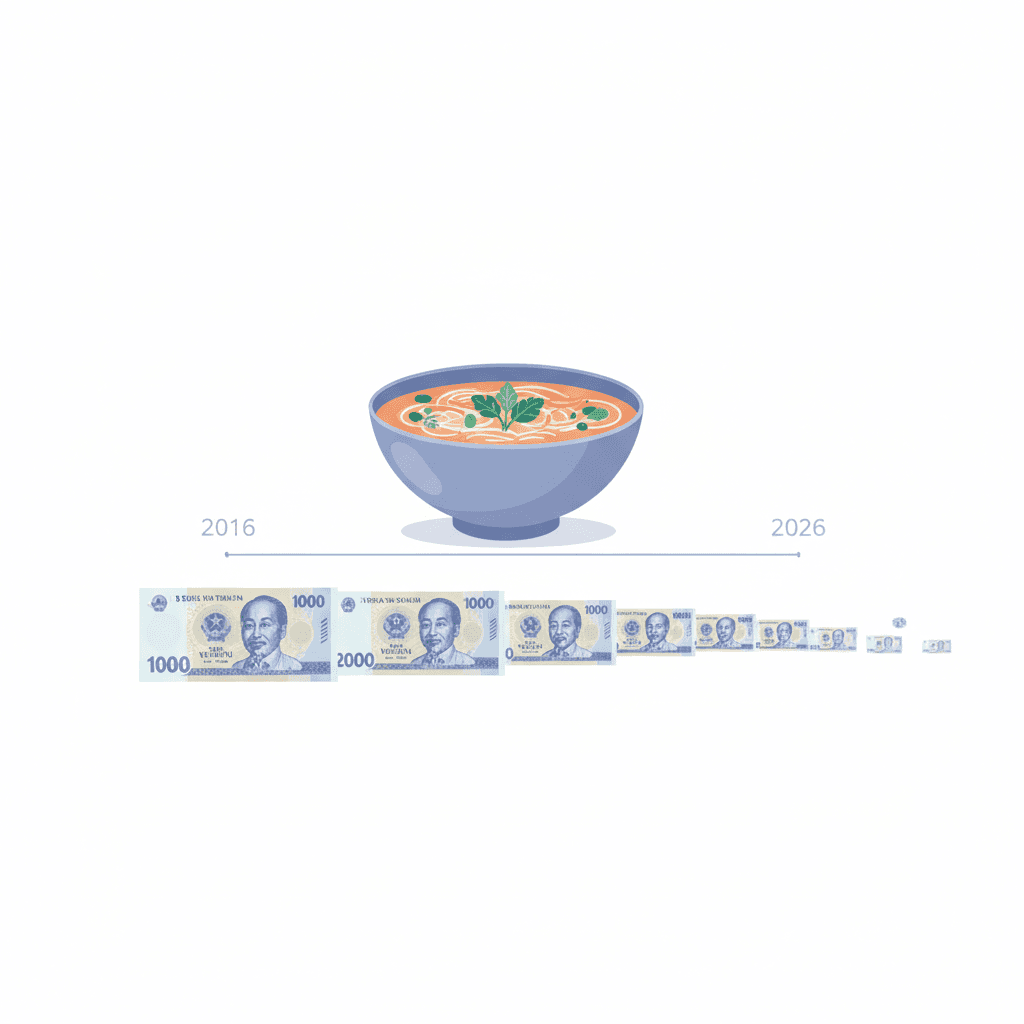
Inflation is the increase in the general price level over time. Put simply: 100,000 VND today is worth more than 100,000 VND a few years from now.
Let’s look at a practical example in Vietnam:
2016: With 100,000 VND you could buy nearly 3 bowls of pho (around 35,000 VND per bowl).
2026: With the same 100,000 VND, you can only buy 1 bowl of pho (prices have risen to around 70,000–80,000 VND per bowl) and have some loose change left — not enough for a second bowl.
The bowl of pho hasn’t changed, but the quantity you can buy has fallen. That is how inflation quietly “eats away” at your money’s purchasing power.
Why Can Savings Still “Lose Value”? It’s About Purchasing Power
To answer the question “does saving lose value?”, you need to distinguish between:
Nominal value: The balance shown in your banking app.
Purchasing power: The amount of goods you can actually buy with that money.
When prices rise faster than your bank interest rate, you may see more money in your account but be able to buy less in real life. This is why many people start asking: is saving enough for long-term goals?
Saving is still essential for:
An emergency fund
Short-term goals (under 1 year)
Peace of mind
However, if you rely solely on savings for goals 5–10 years away, inflation becomes your biggest risk.
What Is the Real Interest Rate? Example with 10 Million VND
Here is a simple formula you can use to check your own situation and understand what a real interest rate is:
Real interest rate = Savings interest rate – Inflation rate
Practical example with 10,000,000 VND:
Savings at 5% per year: After 1 year, you have 10.5 million VND.
Inflation at 6% per year: An item that cost 10 million VND last year now costs 10.6 million VND.
Result: You earned 500,000 VND in interest, but you are still 100,000 VND short of buying the same item. The money didn’t disappear — its purchasing power shrank.
Two Mistakes to Avoid: “Standing Still” and “Going All In”
The “standing still” trap: Holding all your money in cash because you fear risk. Over the long term, purchasing power is guaranteed to erode.
The “all-in” trap: Being so afraid of inflation that you put all your money into high-risk investments without knowledge. This is the fastest way to lose money due to panic during market volatility.
A safer approach is to separate money by time horizon:
Short term: Prioritise savings for safety and flexibility.
Long term: Choose disciplined growth plans such as stocks or ETFs, aligned with your risk tolerance.
A 4-Step Plan to Stop Your Money “Evaporating”
You cannot stop inflation, but you can protect your money from inflation through your actions:
Build an emergency fund first: Keep 3–6 months of living expenses in a safe, accessible place (such as a bank deposit).
Invest only surplus money: Use only money you are certain you will not need for the next 3–5 years.
Start small: For example, 500,000 VND per month to build habits and strengthen your psychology.
Think ownership: Shift from simply holding VND to owning shares in leading global companies through Teko.
From “Playing the Stock Market” to “Owning Businesses”
1. What is inflation in simple terms?
Inflation is the gradual increase in prices over time. It means that the same amount of money buys fewer goods and services in the future than it does today. For example, if food, rent, and transport all become more expensive, your money loses purchasing power.
2. Does saving money in the bank lose value because of inflation?
Not always — but it can in real terms.
If your savings interest rate is lower than the inflation rate, your money may grow in number but shrink in purchasing power. This is why understanding the real interest rate (interest minus inflation) is important.
3. Is saving money still necessary if inflation exists?
Yes. Saving is essential for:
Emergency funds
Short-term goals
Financial stability and peace of mind
However, for long-term goals (5–10+ years), savings alone may not be enough to outpace inflation.
4. How can beginners protect their money from inflation?
A simple approach:
Build a 3–6 month emergency fund.
Invest only money you do not need in the next few years.
Start small and invest consistently.
Focus on long-term ownership of productive assets rather than holding only cash.
Subscribe to our newsletter
Stay sharp with curated tips, feature updates, expert insights, and to exclusive content delivered to your inbox every week. No spam, ever.