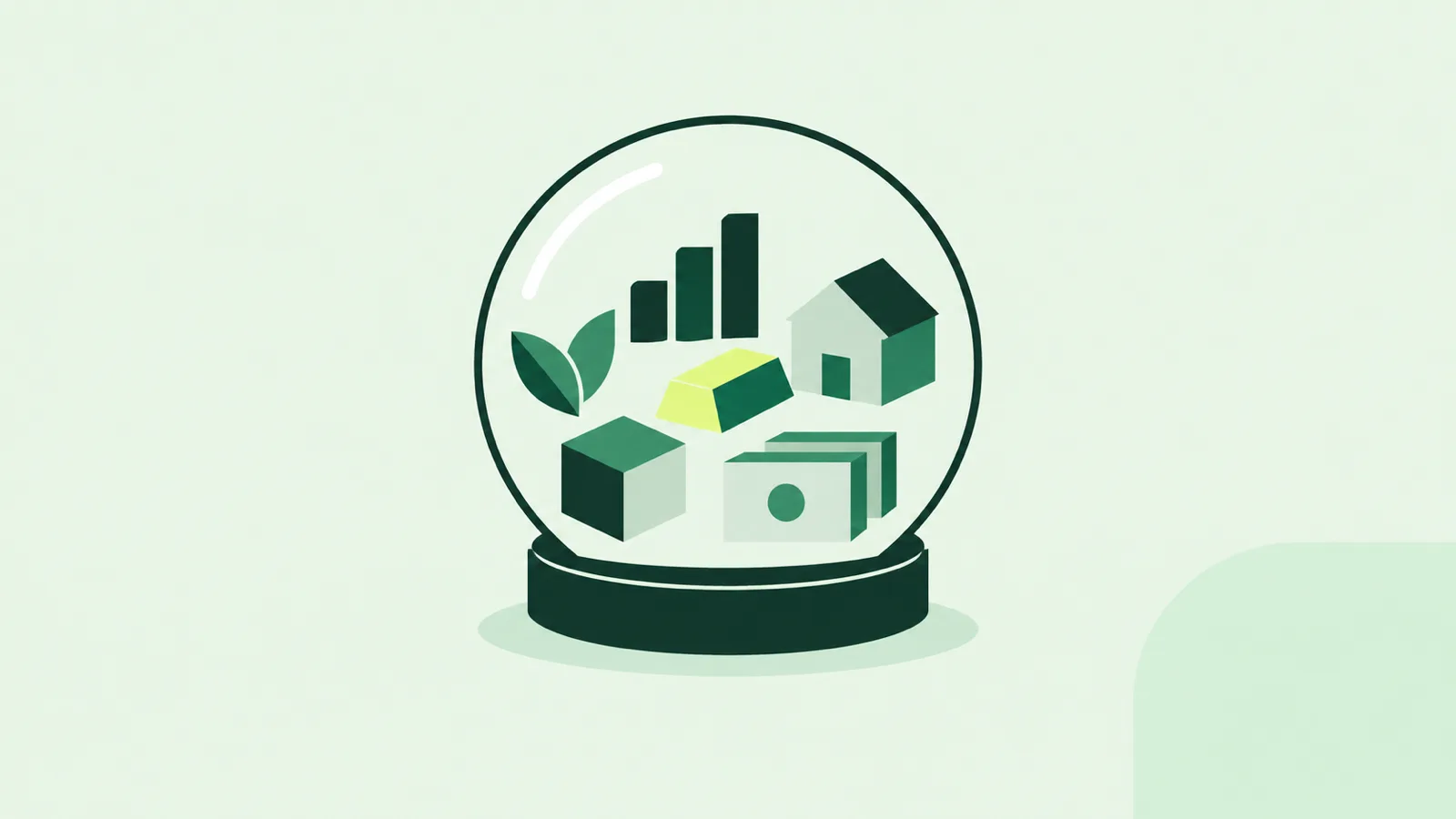
An ETF is a basket packaged as one fund unit: it trades on a stock exchange like a share, but it usually represents a portfolio of assets such as stocks, bonds or commodities.
A broad-market ETF spreads company risk: it can reduce how much you depend on any single company, but its price can still fall when the market or the assets inside it fall.
Look inside before you judge an ETF: check what it holds, which rules or index it follows, what it costs and how easily it trades.
Get your foundations in place first: have an emergency fund, deal with high-interest debt, and invest only money that fits a long-term goal.
What is an ETF?
An ETF, or exchange-traded fund, is an investment fund that is listed and traded on a stock exchange, just like a share. Each ETF unit represents a slice of the portfolio the fund holds. Many ETFs track an index such as Vietnam's VN30 or the US S&P 500, so for a stock ETF a single purchase can give you exposure to many companies at once.
Put simply, an ETF is a basket of assets packaged into fund units that trade on an exchange. The basket might contain stocks, bonds, commodities, or a group of assets that follows a particular index.
One key point: an ETF is not an individual stock. When you buy ETF units, you hold an economic interest in a portfolio that the fund owns. You do not personally own each share inside that portfolio.
A simple way to remember it:
ETF = fund units + a portfolio inside + trading on an exchange
A simple example: a shared family meal instead of a single dish
Imagine you have VND 10,000,000 of spare money and you are learning how to invest.
If you put all of it into one stock, your result depends heavily on one business. If that company runs into problems with profits, management or competition, or its industry declines, your portfolio could take a big hit.
If you choose a broad-market ETF instead, one fund unit can give you exposure to many companies at the same time. For example, an ETF that tracks the S&P 500 usually holds shares in many large US companies, following the index's rules. Your result no longer depends entirely on a single business.
Think of it like ordering a balanced family meal with several dishes rather than just one plate. If one dish is not to your taste, the rest of the meal is still there. But if the whole restaurant has a problem, meaning the overall market falls sharply, the entire meal can still be affected.
How does an ETF work?
An ETF usually has three layers:
The portfolio inside: an ETF can hold tens, hundreds or even thousands of assets.
The investment rules: the portfolio usually follows a clear rule, such as tracking a market index, a sector, a geographic region or an asset class.
Trading on an exchange: investors buy and sell ETF units during trading hours, much as they would trade shares.
Some ETFs track broad indexes, such as a US stock index or a global index. Others focus on narrow areas such as technology, energy, semiconductors, bonds, gold or a particular investment theme.
That is why the label "ETF" alone tells you very little. You need to look at what the ETF holds, which rules it follows, what it costs, and whether it fits your goals.
How is an ETF different from an individual stock?
An individual stock represents ownership in one specific company. An ETF represents an interest in a portfolio of many assets.
If you buy shares in one company, your result depends heavily on that company: its revenue, profits, management, industry, valuation and what the market expects from it.
If you choose a broad-market ETF, your result depends on the whole portfolio inside it. Sharp falls in a few companies may be partly offset by others, but if the overall market falls, the ETF can still fall.
You can explore this difference in more depth in the lesson on stocks vs. ETFs. For now, remember:
Individual stock: concentrated in one business.
ETF: exposure to a basket of assets through one fund unit.
Broad-market ETF: often reduces concentration risk, but does not make investing completely safe.
Why are ETFs often mentioned to beginners?
ETFs come up often in investing education for four reasons.
First, ETFs help new investors learn about diversification. Instead of putting your whole result on one ticker, you can watch how a basket of assets moves together.
Second, many ETFs follow transparent rules. You can often look up the holdings, the weight of each asset, the reference index, the management fee and the fund documents.
Third, ETFs may suit a habit of investing regularly better than trying to pick short-term "winning stocks". Regular investing still takes discipline, time and the ability to live with price swings.
Fourth, ETFs help you understand many foundational ideas, such as indexes, diversification, fund fees, liquidity, dividends, exchange rates and market risk.
But ETFs are not the answer for everyone. A narrow sector ETF, a leveraged ETF or an ETF built around a hot theme can be far riskier than a broad-market ETF.
What are the common types of ETF?
Not all ETFs are alike. Some common groups are:
Broad-market index ETFs: track a major index such as the S&P 500 or a total-market index.
Sector ETFs: focus on one industry, such as technology, financials, energy or semiconductors.
Bond ETFs: hold many bonds and carry their own interest-rate and credit risks.
Commodity ETFs: track assets such as gold or oil and often move with commodity supply and demand.
International or global ETFs: give exposure to several markets, but add exchange-rate, tax, fee and regulatory risks for each market.
At the start, your first question should not be "Which ETF is best?" A more useful question is: "What does this ETF represent, where are its risks, and do I understand it well enough before buying?"
Examples of ETFs in Vietnam
In Vietnam, ETFs are listed on the stock exchange and bought and sold through a securities account, just like shares. Two examples that are often mentioned:
E1VFVN30: an ETF managed by Dragon Capital that tracks the VN30 index, a group of 30 stocks with large market capitalization and liquidity on the Ho Chi Minh City Stock Exchange (HOSE).
FUEVFVND: another ETF managed by Dragon Capital, which tracks the VN Diamond index.
These examples only illustrate how Vietnamese ETFs work. They are not investment recommendations. To compare domestic ETFs with US ETFs by index, currency, fees and access, see the lesson on how Vietnamese and US ETFs differ.
What are the risks of ETFs?
An ETF can reduce concentration risk, but it is still an investment whose price can rise or fall. Here are some important risks. The lesson on ETF risks covers them in more depth.
Market risk: if the market or the assets inside the ETF fall, the ETF's price can fall too. Even a broad-market ETF can drop sharply in a crisis or recession.
Concentration inside the ETF: an ETF that sounds diversified may still depend heavily on a few large companies, one industry or one country. Check the top 10 holdings and the sector weights before concluding that an ETF is "safe".
Liquidity risk: large ETFs are often easier to trade, but small or thinly traded ETFs can have wider bid-ask spreads. When you need to sell, you may not get the price you want.
Exchange-rate risk for Vietnamese investors: if you buy an ETF priced in USD or one that holds international assets, your result in VND depends on the USD/VND exchange rate. An ETF can rise in USD terms while your result in VND is still different from what you expected.
Product and platform risk: you need to know whether you are buying a real ETF, a simulated fund, a CFD or another derivative. Each has different custody arrangements, fees, investor rights, platform risks and rules. If you are looking into this from Vietnam, Investing in US stocks from Vietnam explains fees, exchange rates, taxes, custody and platform risk in more detail.
Some platforms let you trade on an ETF's price when what you actually hold is a CFD (contract for difference). In that case, you do not own any fund units. The lesson comparing real shares, CFDs and simulated products explains the difference.
What should you ask yourself before investing in an ETF?
Understanding ETFs does not mean you should buy one right away. Before you start, check yourself against these questions:
Do I have an emergency fund that covers a few months of essential expenses?
Am I investing money I will need in the short term?
Have I dealt with high-interest debt?
Do I understand what assets this ETF holds?
Can I accept that this investment may fall in the short term?
Do I understand the fees, taxes, exchange rate, liquidity, custody and platform risks?
Am I learning so I understand the product, or buying because many people are talking about it?
If several answers are still unclear, it is a sensible choice to keep learning before you invest. An ETF can be a useful tool, but a tool only works well when the person using it understands its purpose and its limits.
How are ETFs related to the S&P 500?
The S&P 500 is an index. An ETF is an investment product that can be designed to track an index such as the S&P 500.
In other words, the S&P 500 is the measuring stick, and an S&P 500 ETF is one way for investors to get exposure to what that stick measures.
This matters because beginners sometimes say they "bought the S&P 500", when in practice they usually bought an ETF or fund that tracks it. Each product has its own fees, liquidity, dividend policy, tracking difference and trading conditions.
In the US, some well-known ETFs that track the S&P 500 trade under tickers such as SPY, IVV and VOO. These are named only as examples, not as recommendations. The lesson "What is the S&P 500?" explains the index these funds follow.
Next step
One ETF can hold many assets, but that alone does not prove your overall portfolio is diversified. You could own several funds that all lean on the same companies, sector or country. So how can you tell whether your money is really spread out? The next lesson explains diversification and how to spot concentration in a single company, industry or market.
Continue the main path: What is diversification?
This content is for personal finance education only and does not constitute personalized investment advice. Consider your own goals, time horizon, ability to bear losses, and financial circumstances before investing.